Your tyres are arguably the single most important safety component on your vehicle. They are the only part of your car that makes contact with the road surface. Every time you brake, accelerate, corner, or cruise at motorway speed, you are entirely reliant on four patches of rubber, each roughly the size of a human hand to keep you in control.
Yet at Malling Tyres, our technicians see preventable tyre failures week in and week out. Drivers come to us with worn, cracked, and dangerously underinflated tyres that should have been replaced months ago. The scary truth is that most of these situations could have been identified and fixed with a simple five-minute check at home.
This guide walks you through the five most critical warning signs that your tyres need replacing. If you recognise any of these on your vehicle, do not put it off. Worn tyres are not just an MOT failure. They are a serious road safety risk to you, your passengers, and everyone around you.
Sign 1: Tread Depth is Approaching or Below the Legal Limit
The legal minimum tyre tread depth in the UK is 1.6mm across the central three-quarters of the tyre, around the entire circumference. This might sound like a technical specification, but the real-world consequences of falling below this threshold are severe.
Studies by the RAC and TRL (Transport Research Laboratory) consistently show that a tyre at 1.6mm tread in wet conditions has significantly longer stopping distances than a tyre with 3mm or more of tread. In practice, on a wet road at 70mph, the difference can be as much as an additional 44 metres of stopping distance between a new tyre and a legal-minimum tyre. To put that in context that is the length of four double-decker buses.
We recommend replacing tyres before they reach 3mm, not 1.6mm. The difference in wet braking performance between 3mm and 1.6mm is significant enough that many motoring experts, insurers, and the European Tyre and Rim Technical Organisation (ETRTO) advise treating 3mm as your personal action threshold. The small amount of extra rubber you save by running tyres down to the legal limit is not worth the increased risk.
Sign 2: Cracks, Cuts, or Bulges in the Sidewall
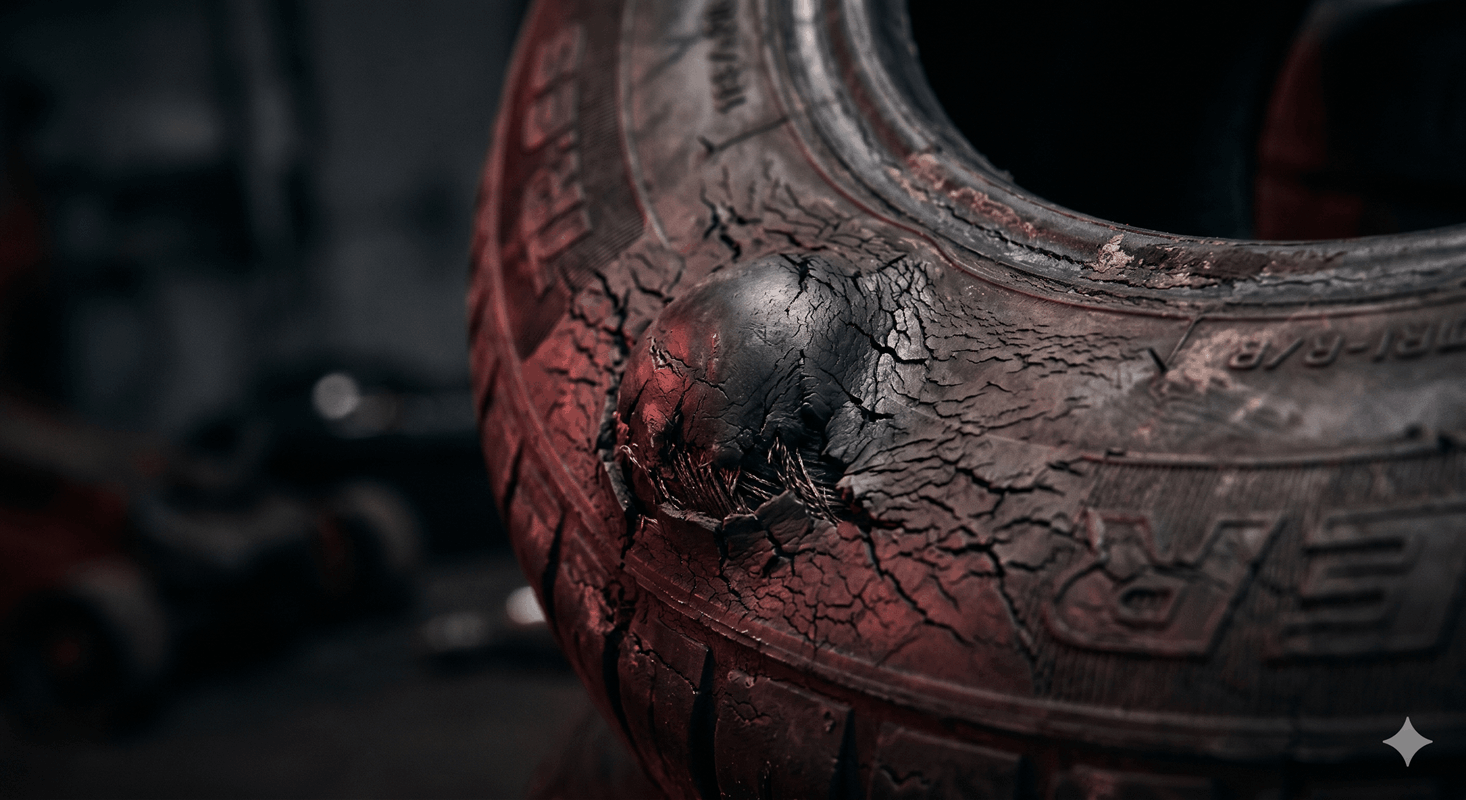
The sidewall is the vertical section of the tyre between the tread and the wheel rim. It is structurally critical, it supports the weight of your vehicle and absorbs road impacts. When you notice cracks, cuts, or bulges in the sidewall, this is your tyre telling you its internal structure has been compromised.
Sidewall cracks often develop from UV exposure, ozone degradation, and age, even if the tread looks fine. They can also result from hitting kerbs, potholes, or driving on underinflated tyres for extended periods. Once the rubber begins to crack, the structural integrity of the tyre is weakened and it is only a matter of time before a catastrophic failure occurs.

A visible bulge in the sidewall means the inner reinforcing plies have failed and air is pushing against only the outer rubber layer. This is a blowout waiting to happen at any speed. If you see a bulge, do not drive the vehicle. Call us immediately on +44 XXXX XXXX and we will arrange emergency assistance.
Run your hand carefully along the inside edge and outside edge of each tyre (with the vehicle safely parked and handbrake on). Feel for irregularities, raised areas, or soft spots. Look for any visible cracking in the rubber. Any tyre showing these symptoms needs professional inspection without delay.
Sign 3: Uneven Wear Patterns across the Tyre
Not all tyre wear is equal. While general wear across the tread is expected and normal, uneven wear patterns are a strong indicator that something is mechanically wrong with your vehicle or that your tyres are operating at the wrong pressure.
1. Centre Wear: Wear concentrated in the middle of the tread suggests chronic overinflation. The tyre is rounded like a ball, making only the centre contact the road.
2. Edge Wear: Wear on both outer edges points to chronic underinflation. The tyre is collapsing slightly, putting pressure on the shoulders instead of the centre.
3. One Sided Wear: Wear on only one edge usually indicates a wheel alignment problem camber angle is off. This also puts stress on suspension components.
4. Patchy or Cupped Wear: Irregular scalloped patterns suggest worn shock absorbers or suspension issues, causing the tyre to bounce rather than roll smoothly.
Uneven wear is important beyond just the tyres themselves. It is almost always a symptom of an underlying mechanical problem that will continue to destroy your new tyres if not corrected. When we replace tyres at Malling Tyres, we always check alignment and advise on any suspension concerns we notice, because fitting new rubber on a misaligned car is money wasted.
Sign 4: Persistent or Recurring Pressure Loss
All tyres lose pressure gradually over time typically around 1 PSI per month through normal permeation through the rubber. This is completely normal. What is not normal is needing to add air every week or two, or finding one tyre consistently lower than the others.
Recurring pressure loss most commonly comes from a slow puncture caused by a nail, screw, or piece of road debris embedded in the tread. These can be surprisingly easy to miss the object itself often acts as a plug, allowing air to seep out slowly rather than all at once. You might not even feel a handling difference until the pressure has dropped significantly.
Other causes include a faulty or corroded valve stem, a cracked rim from pothole damage, or a bead seal failure where the tyre meets the wheel. All of these are repairable or replaceable at relatively low cost but only if you catch them early. A slow puncture left unattended eventually becomes a flat tyre at an inconvenient moment, or worse, a tyre failure at speed.
Sign 5: Your Tyres are more than 5 Years Old
This is the warning sign most drivers never even consider, because the tyre might look perfectly fine on the outside. But rubber is an organic material. It degrades over time through exposure to UV light, heat, ozone, and oxygen, regardless of how much it has been driven on. A tyre that has sat in a garage for five years may have deep internal degradation that is completely invisible from the outside.
The consequences of running aged rubber can be sudden and dramatic. Internal compounds break down, reducing elasticity and increasing brittleness. The reinforcing structure weakens. Heat generated during normal driving can then trigger a sudden structural failure a blowout with no warning.
You can check your tyre’s exact age using the DOT code moulded into the sidewall. The last four digits tell you everything: the first two are the week of manufacture, and the last two are the year. A code ending in “2119” means the tyre was made in the 21st week of 2019, making it over seven years old.
Most tyre manufacturers recommend inspection after five years and replacement no later than ten years, regardless of visual condition. Many insurers are also beginning to ask about tyre age in the event of a claim.
UK legal minimum tread depth
Extra wet stopping distance at legal limit vs new tyre (70mph)
Recommended tyre inspection age regardless of tread
Tyres are not a place to cut corners. The cost of replacing a worn tyre, typically £60 to £150 depending on size and specification is nothing compared to the cost of an accident, a fine for illegal tyres (up to £2,500 per tyre), or three penalty points on your licence.
If you have read through this list and found yourself nodding along, it is time to act. Our team at Malling Tyres in Malling Tyres can inspect all four tyres in under fifteen minutes, advise you honestly on what needs replacing and what is fine, and fit new tyres while you wait. No appointment necessary. No upselling. Just honest advice from people who care about keeping you safe on Kent’s roads.
Drive in any time no appointment needed. Our Malling Tyres team will check all four tyres and give you an honest assessment. Fast, friendly, and professional.