
You have probably experienced it at some point. A mild but persistent vibration that hums through the steering wheel or seat at certain speeds. It might start at 50mph, peak around 65mph, and then fade again above 75mph. You tell yourself it is just the road surface, or a slightly rough patch of motorway. Maybe you mention it to a friend who says theirs does the same. And you carry on, getting used to it, filing it under “things to sort out eventually.”
The problem is that wheel imbalance — the almost always fixable root cause of that vibration — does not sit still while you ignore it. Every mile you drive with unbalanced wheels, the imbalance is transferring oscillating forces into your tyres, wheel bearings, suspension joints, and steering components. What starts as a minor inconvenience quietly escalates into accelerated tyre wear, premature bearing failure, and in extreme cases, a genuine safety risk at motorway speed.
At Malling Tyres we balance every set of tyres we fit as standard — because fitting tyres without balancing them is like fitting new brake pads without bedding them in. This guide explains exactly what wheel balancing is, why it matters so much more than most drivers realise, and how a simple service that takes under thirty minutes can protect hundreds of pounds worth of tyres and suspension components.
What is Wheel Balancing and How Does it Work?
A tyre and wheel assembly, even a brand new one straight from the manufacturer, is never perfectly uniform in its mass distribution. Every tyre has microscopic variations in rubber thickness from the moulding and curing process. Every wheel has minor variations from the casting or forging process. When combined, these variations mean the assembly has a “heavy spot” a point where more mass is concentrated than the opposite side.
When a perfectly balanced wheel rotates, the centrifugal force is equal at every point around its circumference, the wheel spins smoothly with no net force pushing it in any direction. When a wheel has a heavy spot, centrifugal force causes that heavier point to pull outward as it rotates, creating a cyclical up-and-down or side-to-side force that is transmitted through the wheel bearing and suspension into the chassis and steering system. At low speeds this is imperceptible. As speed increases, the frequency of this cyclic force increases and it manifests as vibration.
Balancing is the process of correcting this mass imbalance. The tyre and wheel assembly is mounted on a computerised balancing machine. A spindle that spins the assembly at speed while sensors measure the magnitude and precise rotational position of any imbalance. The machine calculates exactly how much counterweight is needed and precisely where it should be placed on the wheel rim to bring the assembly into balance. Small clip-on or adhesive weights, typically between 5g and 60g are then attached at the calculated positions.
On a modern computerised machine, this process takes around 60 seconds per wheel. The correction is precise to within a few grams far more accurate than any manual method. Once balanced, the assembly should rotate with effectively zero vibration-generating force at any speed within normal road use.
Static vs Dynamic Balancing - Understanding the Difference
There are two types of imbalance that a wheel can have, and a professional balancing service addresses both:
1. Static Imbalance: The heavy spot is concentrated at a single point around the circumference of the tyre, causing the wheel to hop up and down as it rotates — like a washing machine drum that is unevenly loaded. Static imbalance creates a vertical bouncing force and is the primary cause of vibration felt through the seat and floor of the vehicle.
2. Dynamic Imbalance: The heavy spots are offset — there may be more mass on one side of the wheel centreline on one part of the circumference, and more mass on the other side of the centreline at the opposite point. This creates a wobbling, side-to-side force as the wheel rotates — like a spinning top that is tilted. Dynamic imbalance is the primary cause of vibration felt through the steering wheel, particularly on front wheels
Most computerised balancing machines measure and correct both types simultaneously in a single spin. The machine calculates the correct weight placement at two planes — the inner and outer rim flanges — to cancel both static and dynamic imbalance components in a single correction. This is why professional computerised balancing consistently outperforms older single-plane or manual methods.
What Causes Wheel Balance to Deteriorate Over Time?
A wheel that was balanced perfectly when new can lose its balance over thousands of miles for several reasons, and understanding these helps explain why balancing is not a one-time procedure but a regular maintenance item.
1. Tyre Wear: As tread rubber wears away, the mass distribution of the tyre changes. Uneven wear caused by misalignment, incorrect pressure, or suspension issues, changes the balance profile of the tyre in ways that cannot be predicted when the tyre is new. Even perfectly even wear gradually alters the balance as the tyre’s mass distribution evolves.
2. Balance Weight Loss: The small clip-on weights attached to the rim during balancing can be knocked off by kerb strikes, car wash brushes, or general road debris. Even one lost weight can introduce enough imbalance to cause noticeable vibration, particularly if it was a larger weight correcting a significant imbalance.
3. Tyre Damage and Repairs: Any repair to a tyre including a puncture repair, changes the tyre’s mass distribution. A properly repaired tyre should always be re-balanced after the repair is completed.
4. Wheel Damage: Pothole impacts, kerb strikes, and road debris can deform the wheel rim or cause localised mass changes that affect balance. If a wheel is damaged and repaired or even just bent and straightened it must be re-balanced.
5. Seasonal Tyre Changes: Every time tyres are swapped summer to winter or back the assembly is different from when it was last balanced, and a fresh balance is essential.

If your car develops a new vibration immediately after having tyres fitted elsewhere, it is almost certainly a balancing issue. Either the tyres were not balanced, one or more balance weights were applied incorrectly, or a weight has already been lost. Bring the vehicle to us and we will diagnose and correct it even if the tyres were not fitted here.
The Real Damage Unbalanced Wheels Cause
The vibration you feel is just the symptom. The mechanical damage happening underneath the car is the real problem and it accumulates silently with every mile.
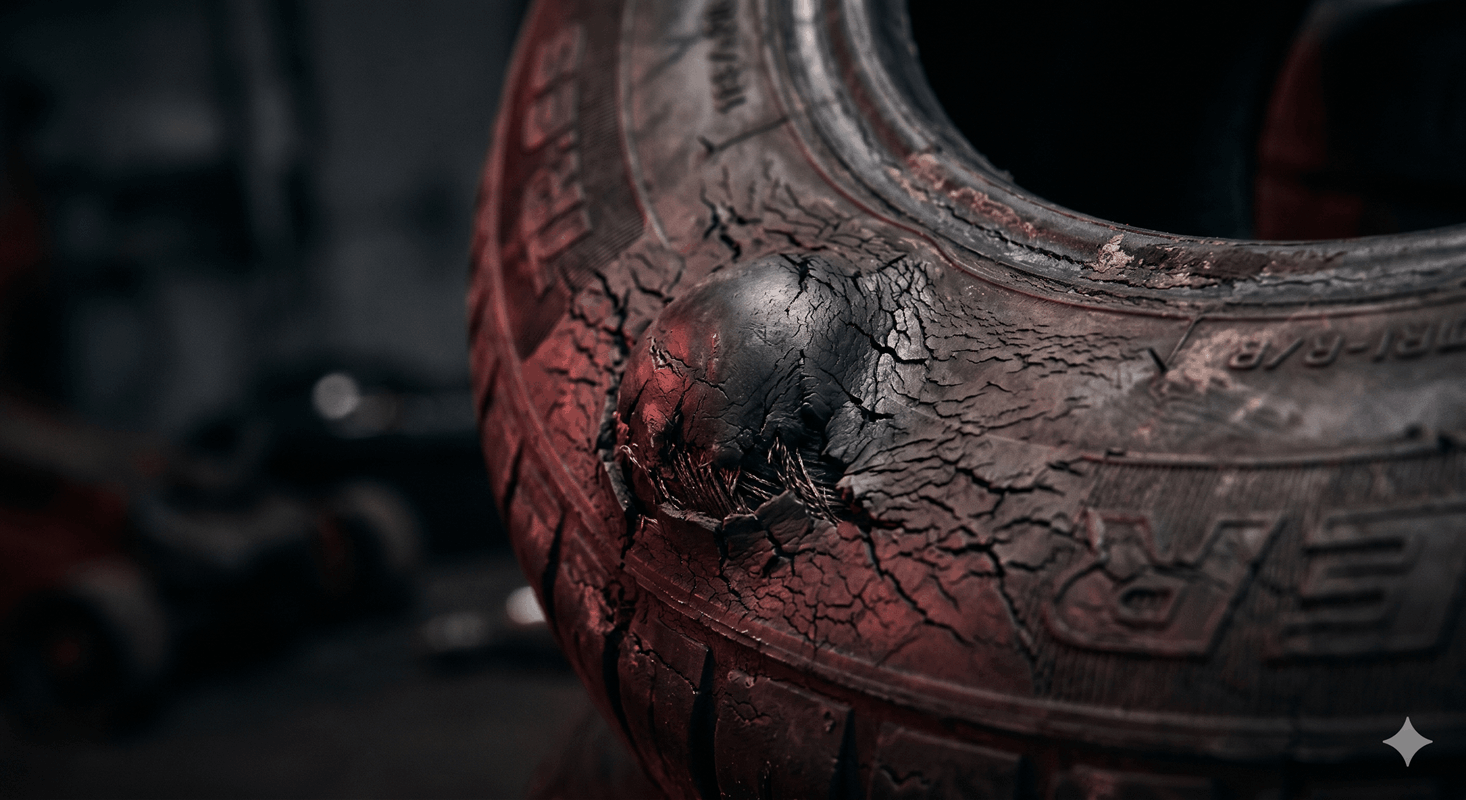
Tyres bear the brunt of imbalance forces directly. The cyclic hammering of a heavy spot against the road surface at high frequency creates a distinctive cupping or scalloping wear pattern areas of the tread that are hammered flat while adjacent areas are relatively unworn. This wear is completely irreversible once established. A tyre with significant cupping wear cannot be repaired by balancing alone the wear pattern is permanent and creates its own ongoing vibration and noise even after the imbalance is corrected. In severe cases, cupped tyres need replacing even when the overall tread depth appears adequate.
Wheel bearings are particularly vulnerable to imbalance forces. Bearings are designed to handle radial (load-bearing) and axial (lateral cornering) forces. the forces created by normal driving. They are not designed to absorb high-frequency cyclic hammering from imbalance. Sustained imbalance accelerates the raceway wear inside the bearing, eventually causing roughness, noise, and failure. A front wheel bearing replacement typically costs £150–£300 including labour. Replacing all four over time because of chronic imbalance represents a significant and entirely avoidable expense.
How to Recognise Wheel Imbalance Symptoms in Your Car
1. Speed Related Vibration: The clearest indicator. Vibration that appears at a specific speed, intensifies within a speed range, and then reduces above a certain speed is almost always imbalance. The specific speed at which vibration peaks depends on the tyre size and the severity of the imbalance.
2. Steering Wheel Shimmy: A side-to-side oscillation in the steering wheel, typically felt most intensely between 55–75mph, points to dynamic imbalance in one or both front wheels. This is one of the most commonly ignored symptoms many drivers mistake it for a characteristic of their car rather than a problem that needs fixing.
3. Vibration Felt through the Seat or Floor: Rear wheel imbalance typically manifests as vibration felt through the seat cushion or the floor rather than the steering wheel, since rear wheels are not connected to the steering system.
4. Cupping or Scalloping Tyre Wear: If you run your hand along the tyre tread and feel a rhythmic series of high and low spots rather than a smooth surface, the tyre has developed cupping wear almost always caused by imbalance, sometimes combined with worn shock absorbers.
5. Humming or Droning Noise at Speed: A rhythmic humming that changes pitch with speed can indicate either imbalance or a failing wheel bearing. Both need professional diagnosis and both are much cheaper to fix early than late.
How Often Should You Balance Your Wheels?
As a general guideline, wheel balancing should be performed every time new tyres are fitted, without exception. Beyond that, we recommend a balance check every 10,000–12,000 miles as part of routine tyre maintenance, or whenever you notice any of the symptoms described above. If you rotate your tyres (moving fronts to rear and vice versa to even out wear), each rotation should be accompanied by a fresh balance on all four wheels, since the balance profile of each tyre will have changed since it was last balanced on that axle.
Increase in imbalance force from 30mph to 90mph (force scales with speed squared)
Typical cost per wheel for professional computerised balancing
Typical cost of a front wheel bearing replacement, easily accelerated by chronic imbalance
The cost-benefit case for regular wheel balancing is clear. A full four-wheel balance at Malling Tyres costs a fraction of what a single set of prematurely worn tyres costs, let alone a wheel bearing or suspension component. It takes under thirty minutes. And the improvement in ride comfort, steering precision, and driver confidence is immediately noticeable.
If your car has been vibrating for weeks or months and you have been putting off doing anything about it, this is your reminder that the longer you wait, the more damage accumulates. Our team at Malling Tyres on Foster Street, Maidstone can balance all four wheels while you wait no appointment needed, same-day service as standard.
If you have read through this list and found yourself nodding along, it is time to act. Our team at Malling Tyres in Malling Tyres can inspect all four tyres in under fifteen minutes, advise you honestly on what needs replacing and what is fine, and fit new tyres while you wait. No appointment necessary. No upselling. Just honest advice from people who care about keeping you safe on Kent’s roads.
Feeling a shimmy at speed? Drive into Malling Tyres in Maidstone for a precision computerised wheel balance on all four wheels. Same-day service, no appointment needed. Protect your tyres and suspension before the damage builds up.