
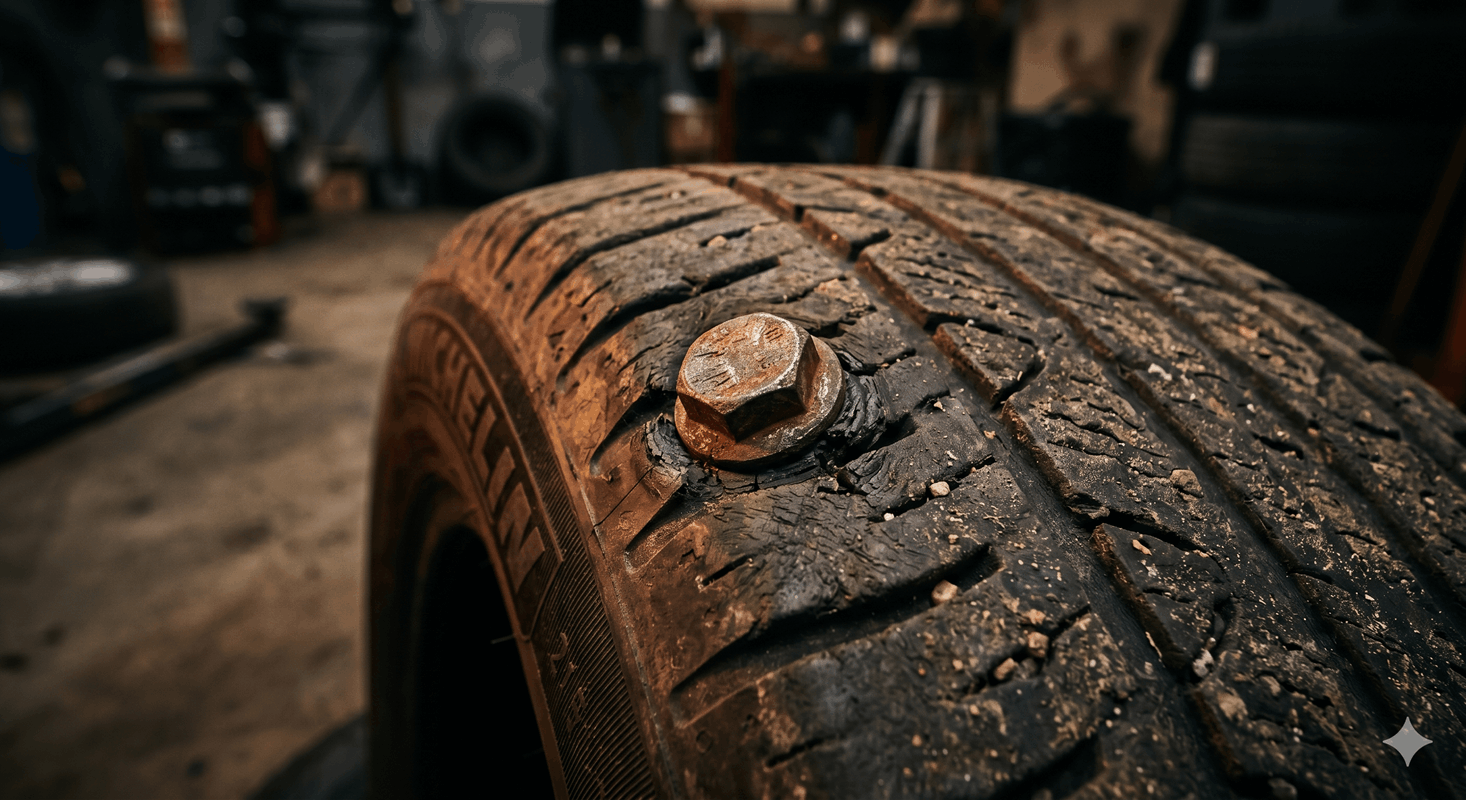
You have driven over a nail. You have noticed one tyre sitting lower than it should. You have heard that slow hissing that no driver wants to hear. And now you are faced with a question that surprisingly few people know the answer to: can this tyre be repaired, or does it need replacing?
The answer has significant financial implications. A professional puncture repair typically costs £20–£30. A new tyre of equivalent specification might cost £70–£150 or more. If a repair is safe and appropriate, choosing replacement is an unnecessary expense. But if a tyre needs replacing and you opt for a repair, you are potentially creating a safety risk that could have serious consequences.
At Malling Tyres, we follow strict industry guidelines for every puncture assessment — the British Standard BSAU 159g and guidelines from TyreSafe, the UK’s leading tyre safety charity. This guide will walk you through exactly how we assess a punctured tyre, what the rules say, and how you can have an informed conversation with any tyre technician about your options.
When a Puncture can be Repaired
Industry guidelines are clear about when a repair is considered safe and appropriate. All of the following conditions must be met simultaneously not just most of them:
1. Location: The damage must be in the central three-quarters of the tread. The “minor repair area” as defined by BSAU 159g. This is the zone where the tyre structure is strongest and where a proper repair can restore the tyre’s integrity fully. Any damage outside this zone in the shoulder or sidewall is not repairable under any circumstances.
2. Size: The penetration damage must be no larger than 6mm in diameter. Larger holes compromise too much of the tyre’s structural fabric and cannot be properly sealed regardless of the repair method used.
3. One Repair per Tyre: A tyre should only ever have one repair. Multiple repairs are not permitted under BSAU 159g, and no two repairs should overlap or be within 40mm of each other.
4. Tread Depth Dufficient: The tyre must have adequate tread depth remaining after the repair to justify the cost and effort. Repairing a tyre with 2mm of tread left makes little economic sense.
5. No Other Damage: The tyre must be free from secondary damage, particularly sidewall distortion, bead damage, or internal degradation from being driven on while flat.
When a Tyre MUST be Replaced - NO Exceptions
There are situations where no repair is appropriate, regardless of how minor the damage appears from the outside. These are non-negotiable for safety reasons:
1. Sidewall or Shoulder Damage: Any cut, tear, or penetration outside the central tread area cannot be safely repaired. The sidewall flexes with every revolution under load, and any repair in this zone will be subjected to forces that will cause it to fail potentially catastrophically at speed.
2. Damage Larger than 6mm: The structural fabric of the tyre cannot be adequately restored if the hole is larger than 6mm. Period.
3. Run-Flat Damage: If the tyre has been driven on while flat or significantly underinflated, the internal structure including the sidewall reinforcement cords and bead area, will have sustained damage that is invisible from the outside. The tyre must be replaced.
4. Bead Damage: The bead is the reinforced edge of the tyre that seals against the wheel rim. Any damage to the bead area prevents a proper seal and makes the tyre unsafe to use.
5. Previously Repaired Tyre with a New Puncture: As noted above, only one repair per tyre is permitted. If the tyre has already been repaired and sustains another puncture, it must be replaced.
6. Tread Depth Too Low: If the remaining tread is near or below 3mm, the tyre should be replaced rather than repaired. The cost of repair relative to the remaining useful life of the tyre does not make economic or safety sense.

Emergency tyre foam (the type that comes in a can) and simple rubber plug inserts, the type available in DIY puncture repair kits are temporary emergency measures only. They are not a substitute for a proper workshop repair and should only ever be used to get you to a tyre centre safely. Using foam also makes it impossible for a technician to perform a proper internal inspection, and some tyre brands will void warranties if foam has been used.
The correct repair method explained
A proper puncture repair, performed to industry standards, involves several steps that cannot be shortcut. Understanding this process helps you recognise when a repair has been done correctly and when it hasn’t.
1. Tyre Removal: The tyre is taken off the wheel completely not repaired on the car with the tyre still mounted.
2. Internal Inspection: The inside of the tyre is thoroughly checked under strong light for secondary damage, cord damage, bead distortion, and internal cracking.
3. Damage Assessment: The puncture is probed and measured. Location and size are confirmed against the repair criteria.
4. Combination Patch-Plug Repair: A proper repair uses a combination unit a mushroom-shaped insert that both fills the hole from the inside out and provides an internal patch that adheres to the tyre’s inner liner. This is the only method approved for permanent repairs under BSAU 159g.
5. Remounting and Balancing: The tyre is refitted to the wheel, inflated to the correct pressure, and rebalanced before being refitted to the vehicle.
The Cost Comparison in Real Terms
| Scenario | Repair? | Typical cost | Verdict |
|---|---|---|---|
| Nail in tread, good tread depth, no internal damage | Yes ✓ | £20–£30 | Repair — safe & economical |
| Nail in tread, but tyre is 5+ years old with 2.5mm tread | Marginal | £80–£140 | Replace — poor value to repair |
| Damage in shoulder area, near tread edge | No ✗ | £80–£150 | Must replace — not repairable |
| Driven flat — tyre visually looks ok | No ✗ | £80–£150 | Must replace — internal damage likely |
| Tyre has existing plug repair, new puncture in tread | No ✗ | £80–£150 | Must replace — second repair not permitted |
How to Protect Yourself From Unnecessary Replacement Recommendations
The tyre industry, like any service industry, has bad actors who will recommend replacement when a repair is perfectly appropriate. Knowing the rules protects you. If a technician tells you a tyre in the centre of the tread with a 4mm nail cannot be repaired, ask them to show you the damage and explain which specific criterion it fails. A reputable tyre shop will welcome this question and answer it clearly. A less reputable one may not.
Equally, if a technician recommends repair and something doesn’t feel right — the repair was done very quickly without removing the tyre, or the price seems too low — it is worth asking whether the tyre was fully dismounted for internal inspection. A £10 “repair” that takes five minutes with the tyre still on the car is almost certainly a plug-only repair that does not meet safety standards and should be replaced as soon as possible.
At Malling Tyres, every puncture assessment is honest and transparent. We follow BSAU 159g without exception. If your tyre can be safely repaired, we will repair it and tell you clearly why. If it cannot, we will show you exactly why and help you find the most cost-effective replacement. We will never recommend a new tyre just to improve our margin.
Maximum puncture size that can be safely repaired
Typical cost of a proper puncture repair
Fraction of tread width that is the repairable “minor repair area”
Drive in or call us at Malling Tyres, Maidstone. We’ll give you a straight answer, repair if it’s safe to do so, replace only if it’s genuinely necessary. No upselling, ever.