To understand the price difference, you need to understand what premium manufacturers invest in that budget manufacturers do not or cannot at the price point they sell at.
Premium tyre manufacturers maintain large, sophisticated research and development operations employing tyre engineers, materials scientists, and computational simulation specialists. Continental’s research centre in Hanover, Michelin’s facility in Clermont-Ferrand, and Bridgestone’s technical centre in Tokyo collectively employ thousands of engineers whose entire focus is improving rubber compound formulations, optimising tread patterns using finite element analysis, and developing manufacturing processes that consistently produce tyres within extremely tight tolerances.
The results of this investment show up in several areas:
1. Compound Chemistry: Premium tyre compounds use sophisticated blends of natural rubber, synthetic polymers, silica, carbon black, and proprietary additives. Silica-based compounds first popularised by Michelin deliver the seemingly contradictory combination of lower rolling resistance (better fuel economy) and improved wet grip. Budget compounds often use simpler formulations that compromise one performance parameter to achieve another.
2. Tread Design Precision: Premium manufacturers use computational fluid dynamics and finite element analysis to optimise every groove, sipe, and block in the tread for specific performance targets. The difference between a well-designed and a poorly designed tread is most visible in wet conditions water evacuation, aquaplaning resistance, and lateral grip all depend heavily on tread geometry.
3. Manufacturing Consistency: A tyre that is slightly unbalanced, has a minor thickness variation, or has a marginally incorrect bead geometry will cause vibration, uneven wear, and handling inconsistencies. Premium manufacturers invest heavily in quality control to produce tyres with extremely tight tolerances. Budget manufacturers may not maintain the same consistency, which is why fitting two “identical” budget tyres can sometimes produce a noticeably different ride quality.
What The Independent Tests Actually Show
The most reliable data on tyre performance differences comes from independent comparative tests conducted by specialist motoring publications — Auto Express, Auto Bild, and Tyre Reviews — and by organisations such as TÜV SÜD and ADAC (the German motoring club). These tests are rigorous, conducted on controlled surfaces, with standardised vehicles and methodologies designed to eliminate variables.
The performance hierarchy revealed by independent testing is broadly consistent: the top premium brands perform best across wet braking, aquaplaning resistance, and handling precision. Mid-range tyres from established brands perform respectably, often within a few percent of premium brands in most tests. Budget brands show much higher variance, some perform adequately, others significantly underperform, and the inconsistency between individual units is greater.
The key insight from years of independent testing data: the difference between a premium and mid-range tyre is often smaller than expected and may not be worth the price premium for many drivers. The difference between mid-range and genuinely poor budget tyres can be significant. particularly in wet conditions. The wisest spend is usually avoiding the very cheapest budget options, not necessarily buying the most expensive premium brand.
Understanding the EU Tyre Label
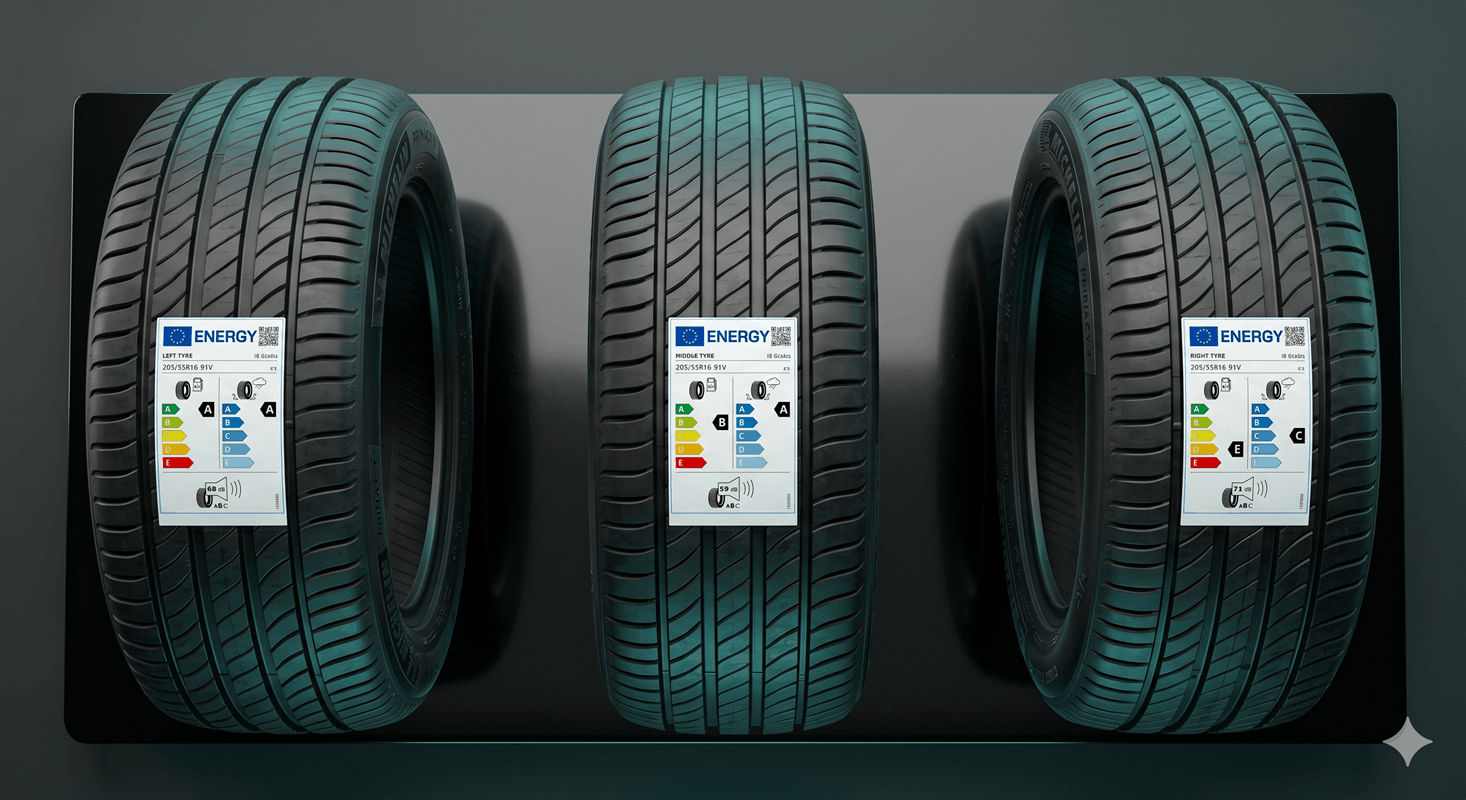
Since 2012, all tyres sold in the EU and UK have been required to carry a standardised label rating them on three criteria: fuel efficiency, wet grip, and external rolling noise. This label, similar in concept to the energy efficiency labels on appliances allows direct comparison between tyres before you buy.
1. Fuel Efficiency (A–G): Rated from A (best, lowest rolling resistance) to G (worst). Moving from a G-rated to an A-rated tyre can save approximately 7.5% in fuel consumption, meaningful over a high-mileage car.
2. Wet Grip (A–G): The most safety-critical rating. A-rated tyres in wet grip deliver the shortest wet braking distances. Moving from a G to an A rating can reduce wet braking distance from 50mph by up to 18 metres. This is significant.
3. External Noise (dB): The sound emitted by the tyre in decibels, plus a wave symbol rating (one to three waves, quieter to noisier).
Our Honest Tier Recommendation
| Driver type | Recommended tier | Why |
|---|---|---|
| High mileage commuter, family car, motorway driving | Premium or strong mid-range | Wet braking and longevity matter most. Michelin, Continental, Bridgestone, Goodyear all excellent. |
| Low mileage, local driving, tight budget | Reputable mid-range | Look for B wet grip rating minimum. Brands like Falken, Nexen, Hankook offer strong value. |
| Performance car, sports driving | Premium, vehicle-specific fitment | Handling precision, heat resistance, and high-speed performance justify the premium spend. |
| Run-around second car, rarely driven | Mid-range with good label ratings | Avoid the very cheapest options — wet grip rating C or below is a meaningful safety compromise. |
| Any driver — budget tyres rated E or F wet grip | Avoid | The wet braking gap at these ratings is large enough to be a genuine safety concern. |
The Tyre Life Calculation
One dimension that rarely features prominently in tyre discussions is longevity. Premium tyre compounds are generally more wear-resistant than budget equivalents — meaning the cost-per-mile difference between a premium and budget tyre is smaller than the sticker price suggests.
A premium tyre costing £130 that lasts 45,000 miles costs approximately 0.29p per mile in tyre cost alone. A budget tyre costing £55 that lasts 22,000 miles costs 0.25p per mile — essentially the same cost per mile, with significantly worse wet performance and greater handling inconsistency. When you factor in the fuel savings from a lower rolling resistance premium compound, the lifetime cost difference often narrows to single figures.
Potential wet braking distance saved, G vs A rated tyre at 50mph
Minimum wet grip EU label rating we recommend for any tyre
Fuel saving potential moving from G to A fuel efficiency rating
The bottom line: the decision between budget and premium tyres is not simply about spending more for better. It is about understanding which performance parameters matter for your driving, using the EU tyre label as an objective guide, and avoiding the genuinely poor performers at the very bottom of the market where safety compromises become meaningful.
At Malling Tyres we stock tyres across all price points and will always give you a straight recommendation based on your vehicle, your budget, and how you actually drive. We will never push you toward the most expensive option if a mid-range tyre does everything you need. And we will always flag if a budget option has wet grip ratings that we would not personally put on our own cars.

Call or visit Malling Tyres in Maidstone. We’ll recommend the best tyre for your car, driving style, and budget, with no pressure to spend more than you need to. We stock premium, mid-range, and quality budget options.