Ask the average British driver when they last checked their tyre pressure and you will get one of three answers: “before my last MOT,” “when the warning light came on,” or a slightly embarrassed “I don’t actually know how.” DVSA statistics suggest that approximately one in three cars on UK roads at any given time is running with at least one significantly underinflated tyre. One in three.
This is not a minor inconvenience. Incorrect tyre pressure has real, measurable consequences for your fuel bills, your tyre lifespan, your vehicle’s handling, and your safety in an emergency situation. The good news is that it is also one of the easiest and cheapest problems in all of motoring to fix, and the savings are immediate and tangible.
In this guide, we are going to break down exactly how tyre pressure affects your running costs, walk you through the maths of what you could save, and give you a simple routine that takes less time than making a cup of tea.
The Fuel Cost of Underinflated Tyres
The relationship between tyre pressure and fuel consumption comes down to a concept called rolling resistance. When a tyre is properly inflated, it maintains its designed shape — the contact patch (the area touching the road) is the right size, the tyre rolls efficiently, and the engine only has to overcome normal road friction to keep the car moving.
When a tyre is underinflated, the sidewall flexes more than intended. The tyre deforms as it rotates, creating a larger, less efficient contact patch and causing the tyre structure to heat up from the repeated flexing. This deformation consumes energy — energy that has to come from your fuel. The more underinflated the tyre, the more energy is wasted, the more fuel you burn, and the more money leaves your wallet at the pump.
Fuel efficiency loss per 6 PSI of underinflation
Estimated annual fuel waste for average UK driver at 6 PSI low
Average monthly pressure loss from normal permeation
To put real numbers on this: the average UK driver covers around 8,000 miles per year and spends approximately £1,800 annually on fuel. Research by Michelin, Bridgestone, and independent motoring bodies consistently shows that a tyre running 6 PSI below its recommended pressure increases rolling resistance by approximately 3%, which translates directly to a 3% increase in fuel consumption. That is roughly £54 per year in wasted fuel just from one underinflated tyre.
Now consider that the average driver who does not check pressure regularly may be running all four tyres 6 to 10 PSI low by the time winter rolls around because tyres naturally lose around 1 PSI per month through normal permeation, and an additional 1 PSI for every 10°C drop in ambient temperature. By February, a car that was checked in September could easily be running 10+ PSI low on every wheel. The fuel waste in that scenario runs well over £100 per year and that is before we consider tyre wear.
The Tyre Wear Cost of Running at The Wrong Pressure
Fuel waste is significant, but tyre wear is where the financial impact of incorrect pressure really compounds. Tyres are not cheap. A quality set of four mid-range tyres for a typical family hatchback a Ford Focus, VW Golf, or similar will cost between £300 and £600. Premium brands can push that to £800 or more. Anything that shortens tyre lifespan costs you real money.
Underinflation causes the tyre shoulders the outer edges of the tread to bear disproportionate load. Instead of the tread wearing evenly across its full width as designed, the edges wear rapidly while the centre remains relatively unworn. This uneven wear pattern means the tyre effectively runs out of tread on the edges long before the centre is exhausted. A tyre designed to last 40,000 miles might be replaced at 25,000 or even 20,000 miles if it has been chronically underinflated a reduction in service life of 30 to 50%.

Running tyres too hard causes the opposite issue the centre of the tread wears faster than the edges, again reducing tyre life. Overinflated tyres also have a smaller contact patch, which increases braking distances and makes the car more sensitive to road imperfections. The correct pressure is not “more is better” it is exactly right.
Over a typical three-year car ownership period, the difference in tyre spend between a driver who maintains correct pressure and one who doesn’t can easily reach £200 to £400. Combined with the fuel savings, you are looking at a potential total saving of £300 to £500 over three years just from checking your tyres regularly. No part, no service, no mechanic required.
The Safety Cost of Getting Pressure Wrong
Beyond the economics, the safety implications of incorrect tyre pressure deserve serious attention. This is not scare-mongering it is physics.
Underinflated tyres generate significantly more heat during normal driving due to the increased flexing of the sidewall and tread. Heat is the enemy of tyre rubber. At sustained motorway speeds with significantly underinflated tyres, this heat build-up can reach levels that weaken the tyre structure rapidly. In extreme cases, this leads to tyre delamination or a sudden structural failure a blowout which at motorway speed is an extremely dangerous event, particularly for larger vehicles or those towing trailers.
Handling is also materially affected. Underinflated tyres have vague, imprecise steering the car feels “floaty” and less responsive. Emergency manoeuvres become less effective because the tyre cannot develop its designed lateral forces. In a sudden swerve to avoid an obstacle, the difference between a correctly inflated tyre and a significantly underinflated one can be the difference between avoiding a collision and not.
Overinflated tyres create different hazards. The smaller contact patch reduces grip, particularly on wet roads. The tyre is less able to absorb road shock, leading to reduced traction over uneven surfaces. And because the centre wears faster, the risk of a sudden puncture from road debris is increased a hard tyre has less ability to deform around sharp objects before they penetrate the tread.
How to Check Tyre Pressure Correctly
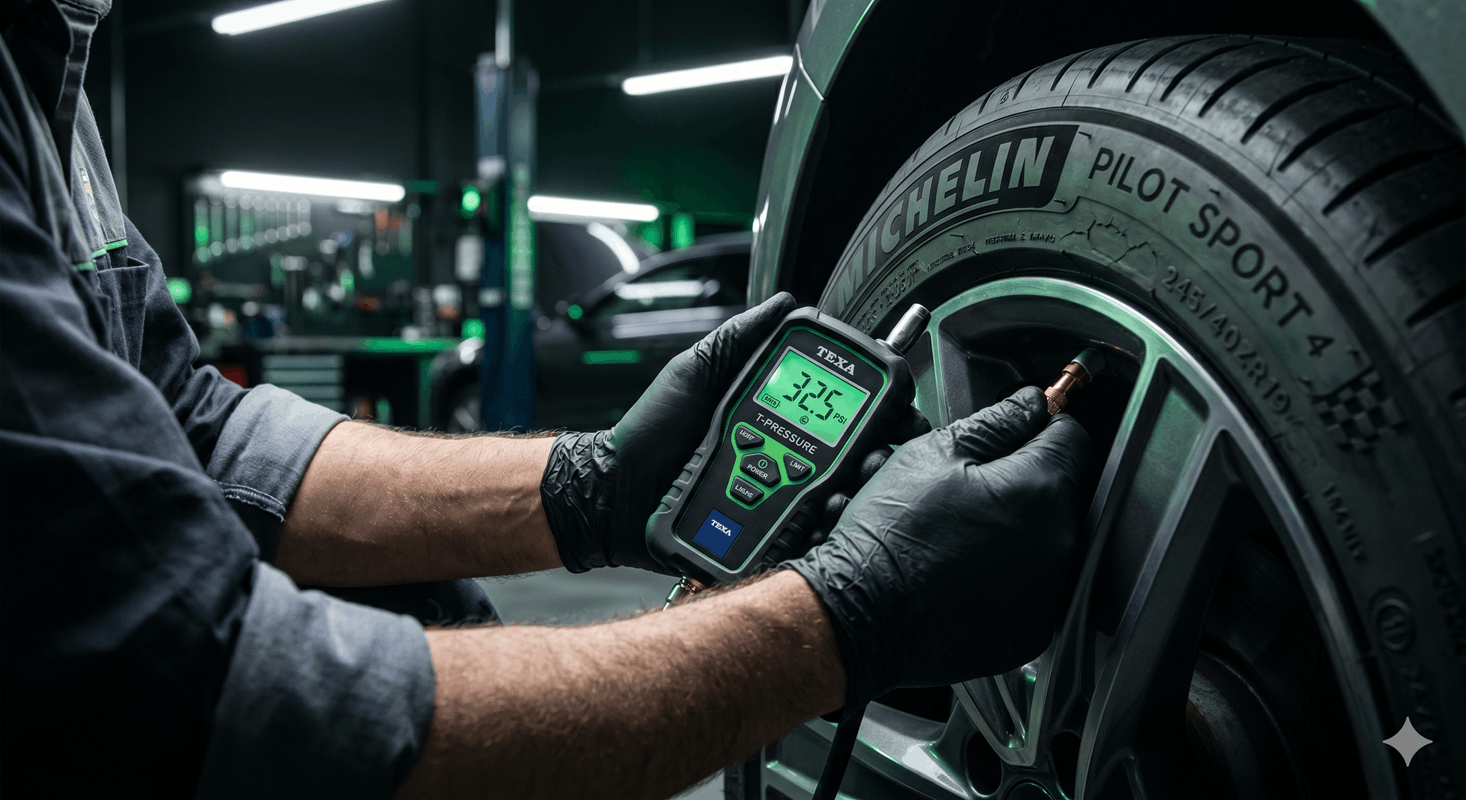
1. Check When Cold: Tyre pressure rises as the tyre warms up during driving. Always check pressure before driving, or after the car has been stationary for at least two hours. Checking a warm tyre will give you a falsely high reading.
2. Find the Correct Pressure: Your recommended tyre pressure is found on a sticker inside the driver’s door jamb, inside the fuel cap flap, or in your owner’s manual. Do not use the maximum pressure printed on the tyre sidewall that is the maximum the tyre can hold, not the recommended operating pressure.
3. Check all Four Tyres: Pressure can vary significantly between individual tyres. Check all four separately do not assume they are equal. Also check your spare if you carry one.
4. Note Your Load: Most cars have two recommended pressures one for normal load (driver plus perhaps one passenger) and a higher pressure for full load (four or five occupants plus luggage). If you are heading on a family holiday with a full car, inflate to the higher load rating.
5. Check Monthly: Set a reminder in your phone for the same day each month. It takes two minutes at a petrol station forecourt. Some forecourts now have free digital tyre pressure machines. This single habit will save you money every year.
When to Let a Professional Help
If you are losing pressure faster than normal needing to top up every week or two there is likely a slow puncture, faulty valve, or rim damage that needs professional attention. These issues do not fix themselves and will eventually leave you with a flat at an inconvenient moment.
If your tyres are showing uneven wear that you suspect may be pressure-related, it is worth getting a professional assessment. Uneven wear can also indicate alignment or suspension issues that will continue to destroy new tyres if not corrected alongside the pressure issue.
At Malling Tyres, we offer completely free tyre pressure checks. Drive in any time during our working hours, and one of our team will check all four tyres, advise on any pressure issues, and top up to the correct specification at no charge. We also carry a full range of quality valves if yours are leaking, and we can repair most slow punctures same-day while you wait.
We genuinely believe that if every driver on Kent’s roads checked their tyre pressure once a month, the county would see fewer breakdowns, fewer accidents, lower fuel bills, and less tyre waste. It is one of the simplest, cheapest, and most impactful things you can do as a responsible car owner.
The maths is simple: two minutes per month, zero cost at most forecourts, and potential savings of £300 to £500 over three years. If you have never made tyre pressure checking a regular habit, there is genuinely no better time to start than right now.
Not sure about your pressures? Suspect a slow puncture? Drive into Malling Tyres on Foster Street, Maidstone. Free check, honest advice, same-day repairs available. No appointment needed.